
Searching for the Roman name for soccer turns up a confident answer that is simply wrong. Latin has no word for the sport. What it has is a family of words for games, balls, courts, and arenas, and the trick is knowing which does which job.
This guide sorts them by what they actually meant, including the wrong one that gets repeated. It also covers the names Romans gave to the ball games they did play, which shows why no single word fits. If you wanted a Roman personal name or a club name instead, that is near the end.
In this guide
- The short answer
- ludus, the general word for a game
- harpastum, the team ball game
- Words for the ball, the court, and the arena
- Why pagina is the wrong answer
- The Latin Romans actually used for football
- If you wanted a Roman personal name instead
- If you wanted a Latin club name
- How to pick the right word for your project
- Frequently asked questions
- The word to walk away with
The short answer

There is no Latin word for soccer. The sport did not exist when Latin was spoken. The Romans had no single term for a football match played with feet.
What exists is narrower and more precise:
- lūdus is the general Latin word for a game or sport. It means any game, not one in particular.
- harpastum is a specific ball game. Romans played it, and it is the closest classical Latin comes to a football-like team game.
- sphaeristērium is the ball court, the place where the games were played.
- harēna is the sand, and by extension the arena. English borrowed this word from Latin.
- pagina means a page or a leaf. It does not mean a ball game.
If you need one Latin word for a soccer club or a project name, lūdus is the general and defensible choice. If you want the historical ball game, use harpastum.
ludus, the general word for a game
The word you want most often is lūdus. It is a masculine noun, second declension, and it is a common word rather than a technical one.
Lewis and Short’s Latin dictionary gives the core sense as “a play, game, diversion, pastime.” In the plural, lūdī means something more specific: public games, shows, and spectacles given in honor of the gods. Those were the state-funded events with chariot races and gladiator fights that the Romans lined up to watch.
There is one wrinkle worth knowing. A ludus also meant a school. Wiktionary records both “a school, especially a primary school” and “game, sport, play.” That dual meaning shaped English. The famous gladiator training ground in Rome was the Ludus Magnus, built by Domitian next to the Colosseum. Romans used one word for both the games and the schools that trained men for them.
So lūdus covers the idea of sport as a whole. It is the Latin equivalent of “game” or “sport,” not of “soccer.”
harpastum, the team ball game
Harpastum is the word for an actual Roman ball game. Wiktionary’s Latin entry calls it “a heavy ball, handball; a handball sport of antiquity played in Ancient Rome.” Lewis and Short is briefer, calling it “a hand-ball.”
The word is a Latinization of the Greek harpaston, from a root meaning “to seize” or “to snatch.” The etymology is worth a moment, because it tells you something about the game. A ball you snatch away from someone sounds like a physical contest.
Here is the honest limit. No Roman writer left a description detailed enough to reconstruct the rules. William Smith’s reference work states that harpastum was “a ball, used in a game of which we have no accurate account.” Two things let scholars infer anything. The etymology points one way, and a remark by the physician Galen points the same way. Together they suggest a ball was thrown among players who each tried to win possession. Martial wrote about the “dusty” version, which tells us it was played on bare ground.
Scholars compare the game to rugby, and it resembles football more than any other Roman game does. Treat that as an informed guess about a game nobody wrote down, not a fact the Romans recorded.
Words for the ball, the court, and the arena
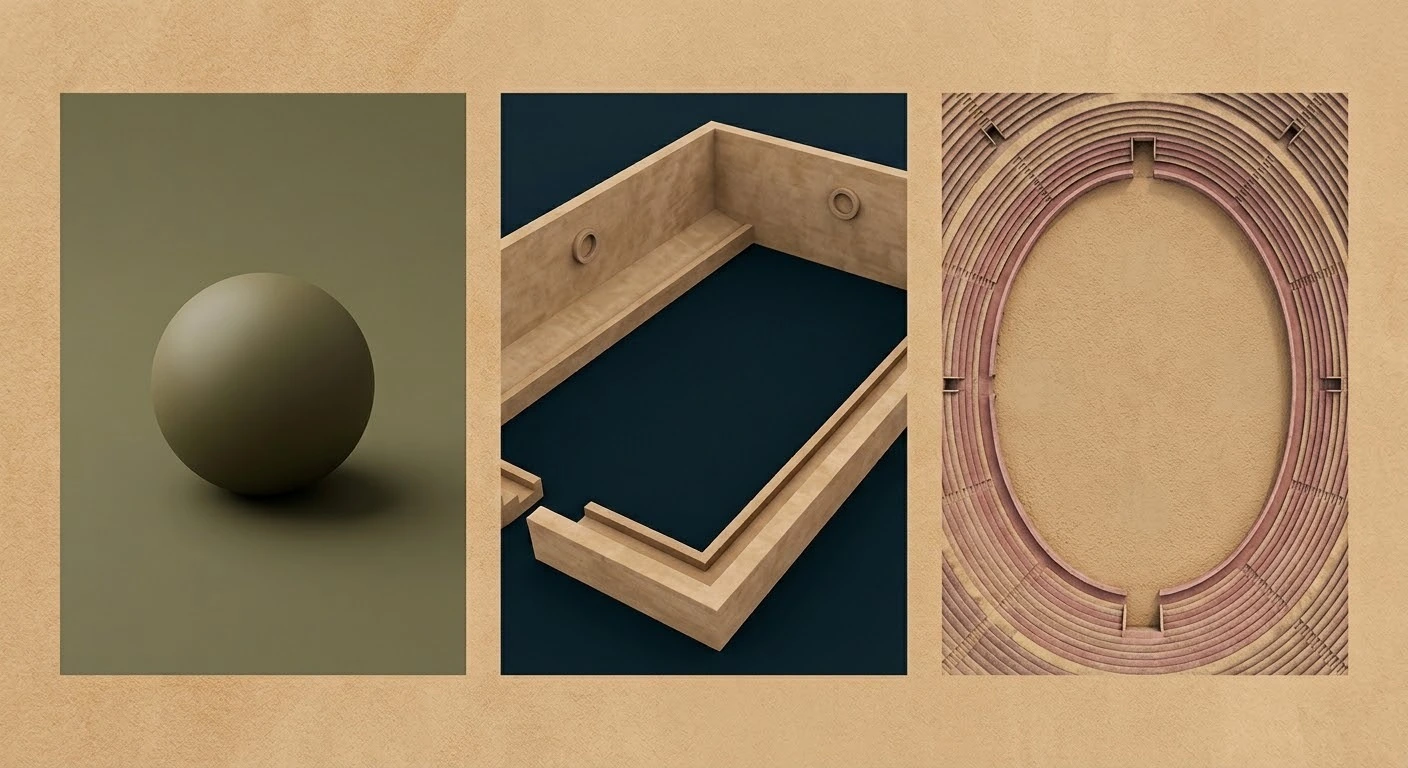
Ball, court, and arena each have a precise Latin term. None of them is the sport.
The ball: pila. The Latin noun pīla means “ball,” and figuratively “a game of ball.” The Roman philosopher Seneca used it that way when he complained about men wasting their whole lives on chess or ball instead of exercise. Be aware that the word has two other common meanings, “mortar” and “pillar,” which is why it trips people up.
The court: sphaeristērium. Lewis and Short gives “a place for playing ball, a ball-court, tennis-court,” citing Pliny and Suetonius. It adds a figurative sense of “a game at ball.” Wiktionary notes these rooms were standard in Roman bath complexes. Men exercised with balls there after being oiled. It describes them as a large open space in the villa or bath building. If your project is about where the game happened, this is the word.
The arena: harēna. Lewis and Short leads with “sand.” From there it moves to a sandy place, a desert, and the shore. Finally it means “the place of combat in the amphitheatre (strewn with sand), the arena.” English took the word directly. Notice the spelling: the classical form is harēna, and arena with a short first vowel is the later variant that English settled on.
The racecourse: circus. Wiktionary gives a circle or orbit first, then a racecourse where games were held, then the spectators themselves. In Roman practice this meant chariot racing at the Circus Maximus, not ball games. It is a useful word for a stadium, but it points at the wrong sport.
Why pagina is the wrong answer
Pagina comes up when people search for the Latin name of soccer. It is wrong, and the dictionaries make the reason plain.
Check the dictionaries. Lewis and Short opens the entry with “a written page or leaf.” The rest of the entry stays in the same family. It covers a page of a letter, a leaf or slab, and an engraved plate listing a person’s titles. Wiktionary agrees, adding a plaque for a statue and later senses for a legal document. The etymology comes from an Indo-European root meaning “to fasten or fix.
Nothing there is a game. Pagina is a page. If you put it on a Latin-themed club crest expecting it to mean football, you have labeled your team with a word for paper.
There is a real word nearby that causes the confusion. Pāgus means a rural district or the countryside, which Lewis and Short gives as “a district, canton, province” and “the country.” That word is the root of pāgānica, the feathered ball we will meet below. Different word, different meaning.
The Latin Romans actually used for football

Latin has no soccer word because Romans got their ball games from the Greeks and kept the Greek names. Smith lists the main Greek modes, and one comes close to football.
Episkyros (Greek: episkyros) was, in Smith’s words, “the game at foot-ball, played in much the same way as with us.” The rest of his description is just as telling. A large number of persons divided themselves into two parties opposed to one another. That means two teams, a line down the middle, and a ball. It was a favorite at Sparta, and it is the closest documented ancient game to modern soccer.
Harpastum is the Latinized form of another of those Greek games. Pāgānica was a third kind, played with a curved stick and a feather-stuffed ball. Smith says it appears in only two passages by Martial. From the second, he concludes the ball was smaller than the large air-filled one and larger than the ordinary small ball.
On the balls themselves, Romans used pīla for any ball. Smith lists three kinds, and most games were played with the small one.
A Latin word that literally means “football” turns up only later. Wiktionary lists pedilūdium as Contemporary Latin for football, glossed as soccer. The Dictionary of Medieval Latin from British Sources, on Logeion, has pedipiludium for “football” and pedipilare for “to play football.” Both are built from pes, “foot,” and either pila or ludus. These are medieval and later coinages, not classical Roman words. Use them for a medieval or modern setting. Do not use them to say what Romans called it.
If you wanted a Roman personal name instead
Sometimes “Roman name” means a person’s first name, not a word for the sport. These are all attested, and each means something.
Florus. Lewis and Short calls it “a Roman surname,” borne by several known Romans including the writer of a short history of Rome. Plain and easy for an English speaker to say.
Sportŭla. Literally “a little basket.” The connection to games is real. Suetonius records that the emperor Claudius called his short public games sportulae, after the little baskets he handed out food and money in.
Florālis. “Of or belonging to Flora,” the goddess of flowers. Gentle and easy to carry, with no athletic baggage.
Victōria. The goddess of victory. Gaffiot’s dictionary gives “Victory, the goddess,” citing Plautus and Cicero. Roman boys were often named after her, so this is a genuine Roman name.
Aurelius. Lewis and Short calls it “a Roman nomen,” the family name carried by Romans from Marcus Aurelius onward. It is the most classically Roman name on this list.
One caution. HarpaX looks perfect for a sports team, being the Latin form of the Greek “snatcher.” But Lewis and Short records it as a slave’s name in Plautus. A Roman would not hear it as flattering.
If you wanted a Latin club name
For a club or team badge, combine a verified Latin word for the game with a place, an animal, or a color. Keep the Latin honest, and let the rest carry the identity.
Game words you can build on
- Ludus or ludi for sport generally
- Harpastum for the historical ball game, and it sounds right for a hard-playing side
- Victoria for victory, if your club name wants to sound triumphant
- Sphaeristerium is too long and too obscure for a badge
Words that work next to them
- Victor, victoris for winner
- Fortuna for luck, a very Roman thing to put on a crest
- Fulmen, meaning lightning bolt, for pace
- Gladius, sword, for strength
How to assemble one
A noun plus a noun, with both in dictionary form, will read as authentic. Ludus Fortunae is “the school of luck.” Harpastum Victor is “the victorious harpastum player.” Singular words are the safe pattern, because Latin plurals change shape and a badge has no room for a wrong ending.
Skip pagina entirely.
How to pick the right word for your project
Decide which of three things you actually need.
You need the Latin word for sport or games as a concept. Use lūdus, plural lūdī for the public spectacles. This is the word for the idea, and it will not mislead anyone.
You need the closest thing to a Roman team ball game. Use harpastum. Be ready to say the rules are unknown, because anyone who knows the topic will ask.
You need the place where the game was played. Use sphaeristērium for a ball court or harēna for the arena. If your stadium has an oval track, circus is the word Romans used for that shape of venue.
Two habits keep you out of trouble. Check the dictionary before you commit, because most wrong Latin fails the way pagina did, by sounding plausible. Use macrons when your project calls for them. Lūdus and harēna are marked long vowels, and adding them costs nothing.
Frequently asked questions
What is the Latin word for soccer?
There isn’t one. Soccer postdates Latin, and the Romans used different words for each of their own ball games. Lūdus is the general word for sport, and harpastum is the closest to a Roman football-like game.
Is harpastum the same as soccer?
No. Harpastum was a heavy-ball team game played with the hands. No Roman source describes its rules in enough detail to map onto any modern sport. Scholars often compare it to rugby. Ancient writers call it dusty, physical, and contested.
What does pagina mean in Latin?
A written page, leaf, or sheet. It also covers an engraved plaque listing someone’s titles, and a rectangular bed of vines in a vineyard. It does not mean a ball game or a game of any kind.
What is the Latin word for a stadium?
It depends on the venue. Sphaeristērium is the ball court attached to Roman baths. Harēna is the sand-strewn fighting floor of an amphitheater, and the source of the English word. Circus is the oval racecourse used for chariot racing.
Which Latin word means “arena”?
Harēna, which means sand first and the arena by extension. English borrowed it directly. The classical form has a long first vowel, so harēna is the careful spelling and arena is the later variant English settled on.
What is the Latin word for a ball?
Pīla, and it can mean the ball or the game played with it. Romans had three kinds: the small pīla, the large air-filled follis, and the feather-filled pāgānica. The same word also means a mortar and a pillar, so check the context when you translate.
Were there Latin-named soccer clubs in antiquity?
No. Roman clubs, where they existed, were organized around professions, neighborhoods, or ethnic communities rather than around a single sport. Latin has the vocabulary for games and ball courts, but not the modern habit of naming a team after the sport.
What Latin name means “victory”?
Victōria, the Roman goddess of victory. Gaffiot’s dictionary gives the sense “Victory, the goddess,” citing Plautus and Cicero. Roman boys were frequently given the name.
The word to walk away with
Latin has no word for soccer, and the honest answer is the general one. Lūdus means sport or game, and it is the word to reach for when you need a single Latin term. Harpastum is the historical ball game, useful and correct as long as you say its rules are lost. Sphaeristērium is the court, harēna the arena, and pīla the ball.
And if you encounter pagina offered as the Latin for soccer, you now know it means a page, and that is the end of it.