
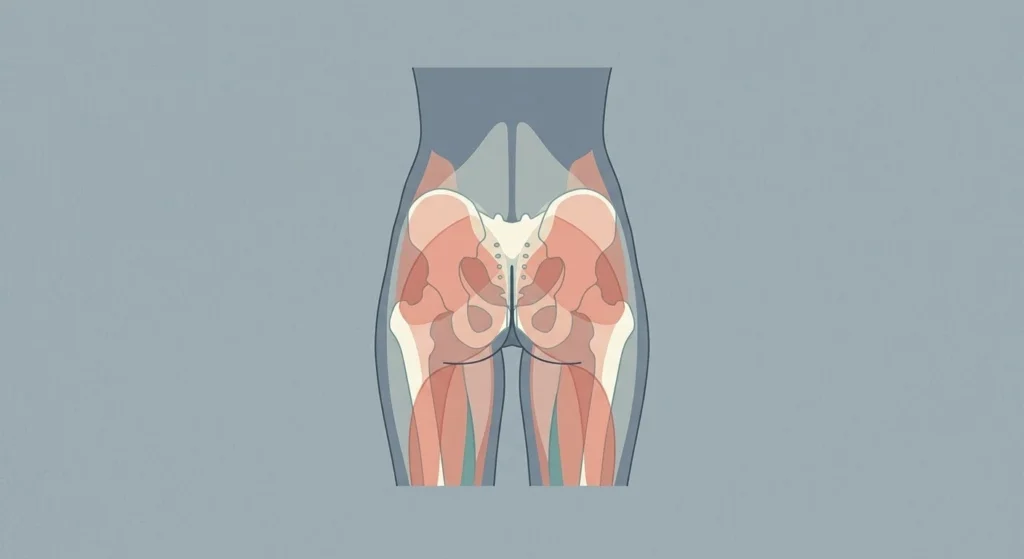
People ask this more often than the question sounds. A doctor writes a word on a chart and the patient does not recognize it. Or someone fills in an intake form and wants the wording the office uses. The plain answer is that there is no single medical name for butt. One everyday word covers muscle, skin, fat, bone, and the groove between the two sides. Anatomy needs a separate name for each of those.
So the useful part is knowing which clinical term points at which part. This guide walks through the main terms, says what each one covers, and shows where they sit in relation to one another.
In this guide
- Why there is no single medical name for butt
- The quick reference table
- Buttock and gluteal region
- The gluteus maximus and the other gluteal muscles
- The bones behind the buttock
- The intergluteal cleft
- Terms people mix up with butt
- How to use these terms when you see a doctor
- Frequently asked questions
- The bottom line
Why there is no single medical name for butt
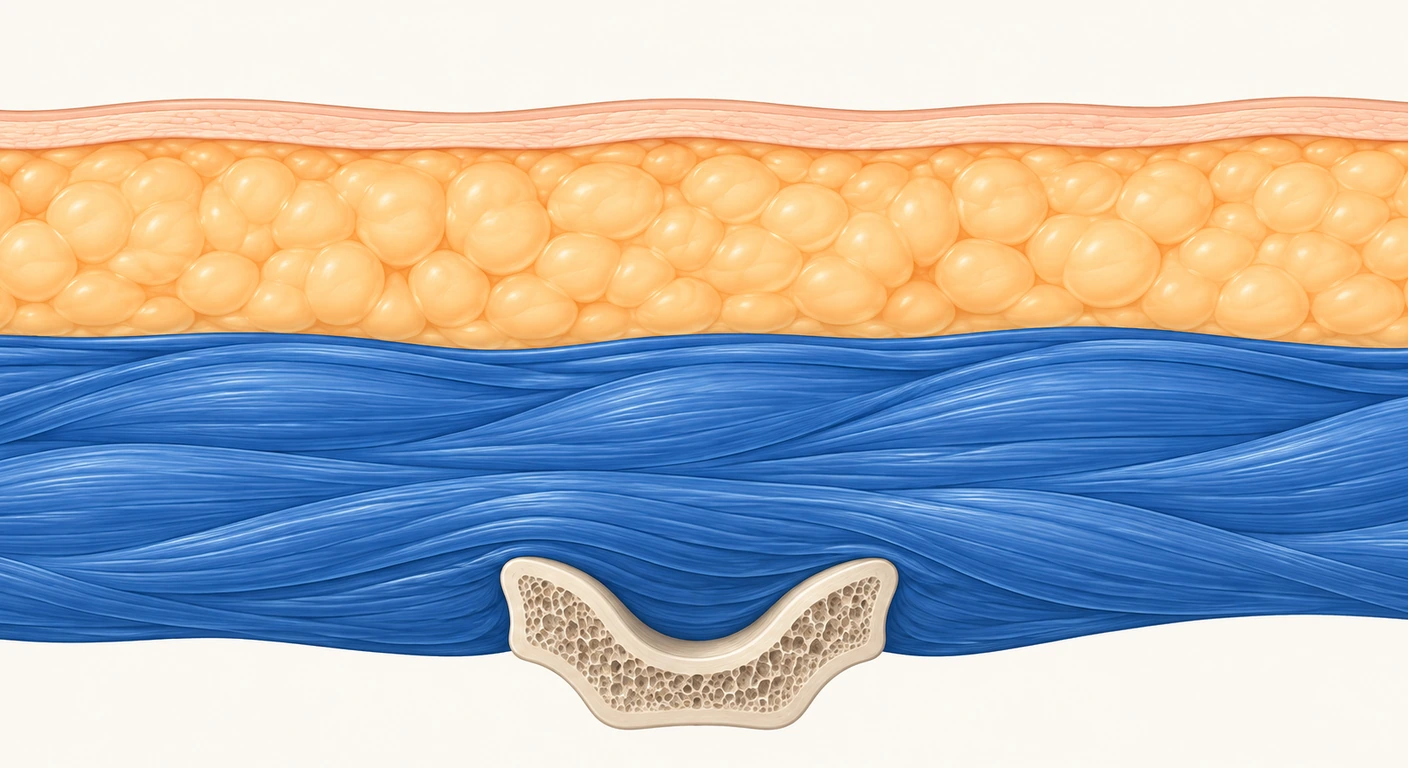
The word butt is a shape, not a structure. Someone who says they have a pain in the butt may mean the muscle under the skin. They may mean the skin itself, the bone deeper in, or the sacrum at the center of the back of the pelvis. Clinicians need to know which one. So a note says “gluteal region” or “left buttock” rather than just “butt.”
There is also a difference between a body part and a body region. A part is a specific piece with its own name and job. A region is a defined area of the body that contains several parts. The buttock is a part. The gluteal region is the area.
The National Cancer Institute’s dictionary entry for buttock calls it one of two round, fleshy mounds of tissue behind the pelvis. The mounds are made up of fat and thick muscle tissue that support the body while sitting. That definition stays at the surface level. It names what you can see and feel, which is useful, but it does not label the muscle or the bone separately.
The quick reference table
| Term | What it names | Plain English |
|---|---|---|
| Buttock | One of the two rounded mounds of tissue behind the pelvis | One side of the butt |
| Gluteal region | The defined anatomical area of the lower back and buttock | The buttock area |
| Gluteus maximus | The largest and most superficial gluteal muscle | The main buttock muscle |
| Gluteus medius and minimus | The two deeper gluteal muscles | The upper side muscles |
| Intergluteal cleft | The furrow between the two gluteal regions | The cleft or crack |
| Sacrum | The triangular bone at the back of the pelvis | The base of the spine |
| Coccyx | The small bone below the sacrum | The tailbone |
| Ilium | The upper part of the hip bone | The top of the hip bone |
| Ischium | The lower rear part of the hip bone | The lower rear hip bone |
| Ischial tuberosity | The bony bump on the ischium | The sitting bone |
| Greater trochanter | The bony expansion of the upper femur | The big bump on the thigh bone |
Buttock and gluteal region
These two terms get used interchangeably, but they are not quite the same thing.
Buttock is a singular body part. One buttock sits on the left side and one on the right. A clinician who writes “left buttock” is naming the left rounded mound of tissue. That dictionary entry also notes what the tissue does. The muscle in it moves the hips and thighs and helps hold the body up while sitting.
Gluteal region is the whole area. Kenhub’s anatomy reference describes it as the posterior surface of the lower limb, lying below the lower back and outside the pelvic cavity. The region runs from the iliac crest at the top down to the gluteal folds at the bottom. The cleft separates it in the middle, and the hip region borders it on the outside. Inside it sit the gluteal muscles and a set of nerves and blood vessels that matter clinically.
The practical difference is one of scope. If someone describes a spot on the upper outer part of the butt, gluteal region is the accurate answer. That spot falls inside a named area with defined borders.
The gluteus maximus and the other gluteal muscles
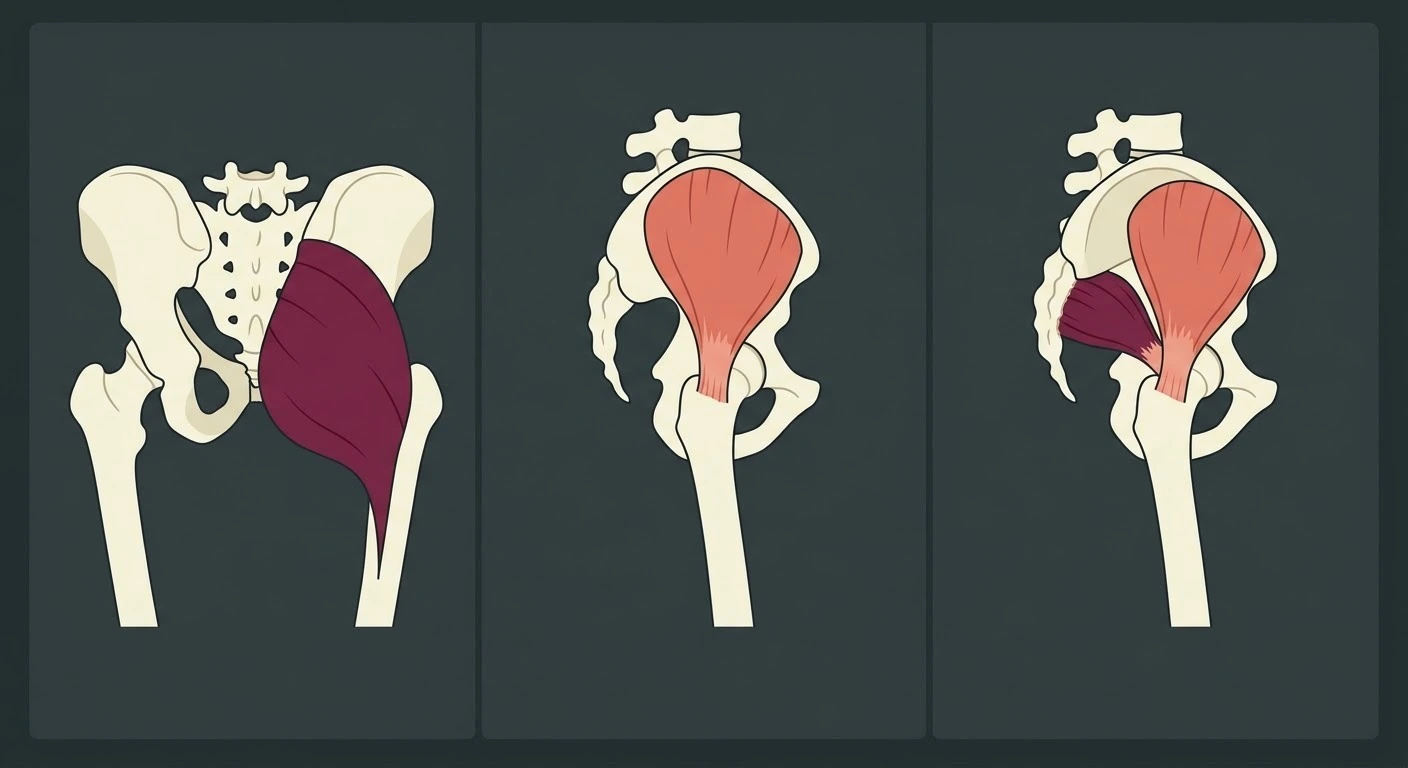
Most people looking for the medical name for butt are really looking for a muscle name. The gluteal muscles are a group of three.
The gluteus maximus is the one most people mean. Kenhub describes it as the most superficial gluteal muscle and the one that forms the visible prominence of the gluteal region. In plainer terms, it is the muscle that gives the buttock its shape. It reaches from the pelvis down to the gluteal tuberosity on the femur, and it works under the control of the inferior gluteal nerve.
Its origin points explain why it sits where it does. It attaches in part to the back of the sacrum and the coccyx. It also attaches to the sacrotuberous ligament and to the flat surface of the ilium. That is a muscle spanning bone across the back of the pelvis.
The gluteus medius sits on the outer surface of the ilium, between the anterior and posterior gluteal lines. The gluteus minimus lies directly under the medius and inserts toward the upper femur. Both are largely covered by the maximus toward the back.
So when a person says “my glutes,” the everyday use of the plural is loose. Anatomically it can point to the whole group or to the maximus alone. Precision requires naming which muscle.
The bones behind the buttock
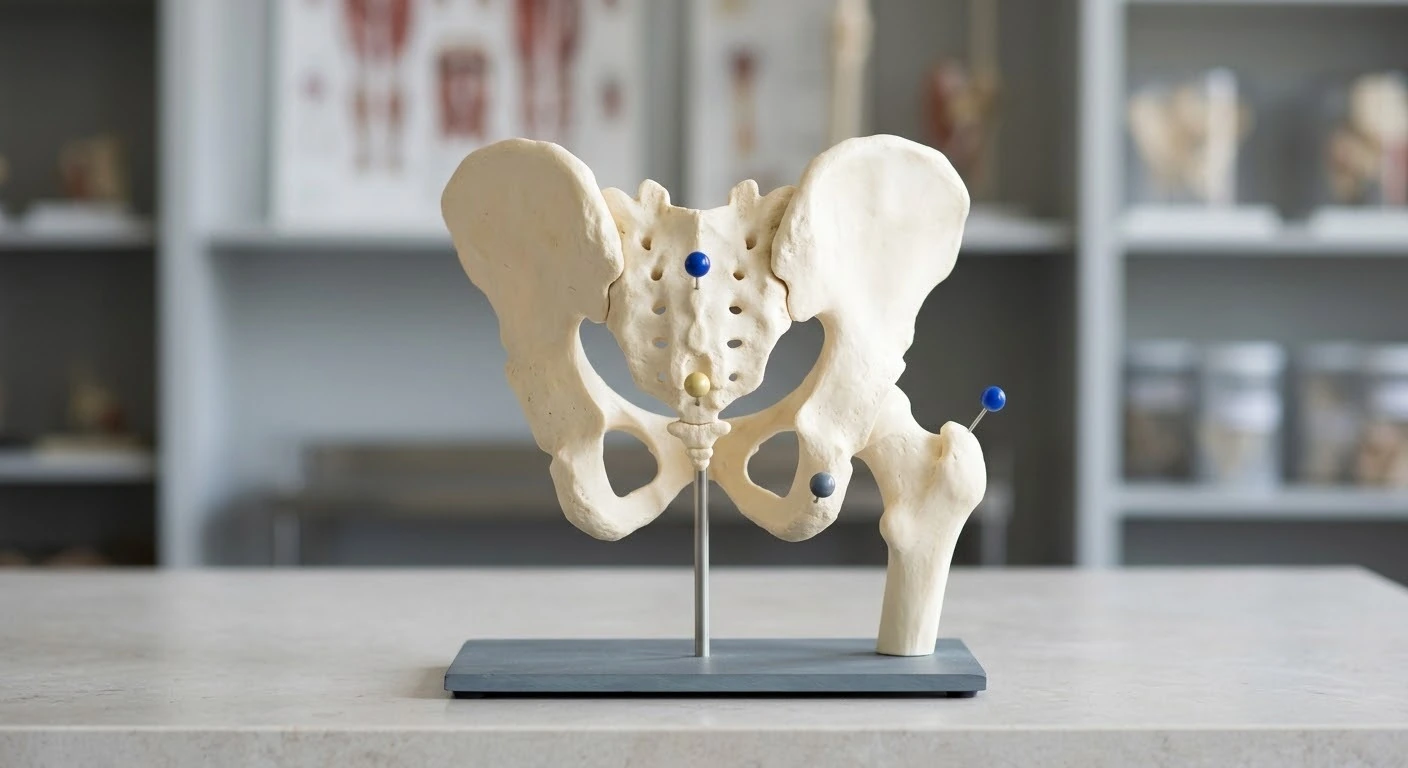
The buttock sits on top of bone, and clinical notes often name that bone rather than the muscle.
Hip bone. The hip bone has several names in circulation. Clinical records may call it the hip bone, the pelvic bone, the innominate bone, or the coxal bone. It forms from three parts that fuse early in life: the ilium, the ischium, and the pubis. The ilium is the top and largest portion, the ischium is the lower rear portion, and the pubis is the front portion.
Sacrum. The sacrum is the triangle-shaped bone at the lower end of the spine that forms part of the pelvis. The NCI describes it as five fused bones. It sits between the two hip bones and gives the pelvis its back wall.
Coccyx. Below the sacrum sits the coccyx, the small bone at the bottom of the spine. It is made of three to five fused bones and is also called the tailbone. Most people know it by the nickname rather than the clinical term.
Ischial tuberosity. This is the point on the ischium where you carry weight when sitting. Kenhub calls it a large round protrusion at the lower rear of the ischium. Kenhub notes it is the “sitting bone,” since body weight rests there when seated. OpenStax’s chapter 8 key terms describes the same landmark as the large, roughened protuberance at the lower rear of the hip bone. Two sources agree, and the nickname makes it easy to place.
Greater trochanter. This one sits on the femur rather than the pelvis. The OpenStax key terms define it as the large, bony expansion of the femur projecting upward from the base of the femoral neck. You can feel this landmark on the outer upper thigh. It sits close enough to the gluteal region that notes about the side of the hip often name it.
The intergluteal cleft
The groove between the two buttock halves has a formal name too. The intergluteal cleft is the deep furrow lying between the two gluteal regions. Kenhub also lists the anal cleft as a synonym.
This is where most people get an answer they did not expect. The cleft is not part of the buttock mounds themselves. It is the separation between them, and it is what gives the region its left and right halves.
Terms people mix up with butt
A few words come up in searches for this keyword and refer to nearby parts instead. Knowing the difference saves confusion at a doctor’s office.
Perineum is the area in front of the anus. The NCI definition places it between the anus and the vulva in females, and between the anus and the scrotum in males. It is not the buttock, but it is close enough that people often assume it is.
Pelvis is the whole bony framework, wider than and higher than the gluteal region. When someone says “hip pain,” they may mean the hip joint, the surrounding soft tissue, or the top of the thigh bone. The gluteal region covers only the back part.
Lower back sits above the gluteal region rather than inside it. The two areas meet along a line, and pain often gets described as coming from one when it is near the boundary.
How to use these terms when you see a doctor
The terminology only helps if it points at the right place. A few habits make the words work for you.
Name the spot in relation to a landmark you can both see. Saying “upper outer part of the left buttock” narrows the area faster than any clinical term. Saying “at the top of the buttock on the bone” tells the clinician you mean the iliac crest area rather than the muscle below it.
Use gluteal region when you mean the whole area. It is the phrase a clinician will recognize, and it covers the full span from the iliac crest to the gluteal folds.
Use gluteus maximus only when you mean that specific muscle. Saying “glutes” or “gluteal” on its own may be taken as the whole group.
Say tailbone or coccyx and they mean the same small bone at the base of the spine. Either wording works in a clinic.
For anything that actually hurts, gets numb, or changes over time, describe what you feel and let the clinician pick the terminology. The words are a way to point at the right area, not a way to work out what is happening. A doctor can examine you and interpret the terms in ways a reference page cannot.
Frequently asked questions
What is the medical term for butt?
The plain anatomical word is buttock, and one person has two of them. Clinicians more often name the area, the gluteal region, or the specific muscle, the gluteus maximus.
Is there one medical word for butt?
No. The everyday word covers muscle, skin, fat, bone, and the cleft between the two sides, and anatomy needs a different term for each of those.
What does a doctor mean by gluteal?
Gluteal is the adjective form of gluteal region. It describes the area at the back of the pelvis running from the iliac crest down to the gluteal folds. Saying “gluteal area” or “gluteal region” points at that whole area.
Is gluteus maximus the same as buttock muscle?
Close, but not identical. The gluteus maximus is the largest and most superficial of the three gluteal muscles and forms the visible shape of the buttock. The buttock itself also includes the skin and fat over it.
What is the crack between the buttocks called?
The intergluteal cleft, also called the anal cleft. It is the deep furrow separating the two gluteal regions.
What is the sitting bone called?
The ischial tuberosity. It is the roughened bump on the ischium, the lower rear part of the hip bone, and it takes your weight when you sit.
Is the tailbone the same as the sacrum?
No. The sacrum is the larger triangle-shaped bone above it, made of five fused bones. The coccyx, or tailbone, is the smaller bone below it, made of three to five fused bones.
Where does the hip bone end and the buttock begin?
They overlap in a way that has no single line. The gluteal region runs from the iliac crest of the hip bone down to the gluteal folds. The ilium is the upper part of that hip bone, so the two names touch without dividing neatly.
The bottom line
The medical name for butt depends on which part you mean. Buttock is the rounded mound. Gluteal region is the whole area. Gluteus maximus is the muscle that gives it shape. Sacrum and coccyx are the bones at the center of the back of the pelvis. Ischial tuberosity is the sitting bone, and the greater trochanter is the bump on the thigh bone beside it. The intergluteal cleft is the groove between the two halves.
Learn which term points where, use the landmark words when you describe a spot, and let a doctor do the diagnosing.