
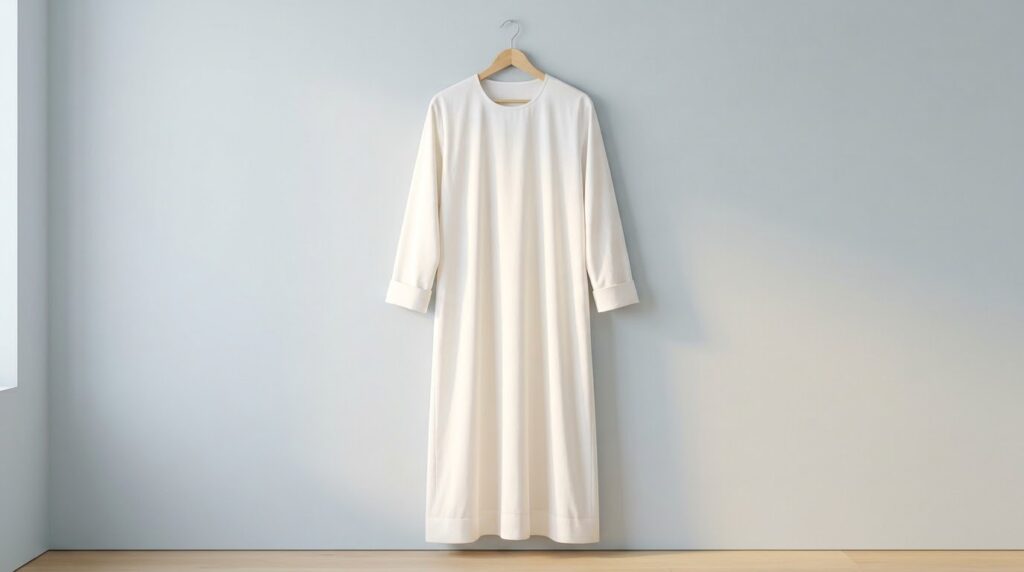
The long white robe you picture when someone says Muslim men’s dress has a name, and the name changes with the country. In the Gulf it is a thobe. In Iraq a dishdashah. In Pakistan a jubbah. The garment barely changes. The vocabulary does.
That is why this search feels confusing. You are looking for a muslim dress name for male, you have no idea where the photo was taken, and every shop calls it something different. Add the tunic, the wide trousers, the small cap, and the formal coat, and one outfit can carry five names in five languages.
This guide breaks the vocabulary down by region. You get the robe names first, then the tunics and trousers, then the West African and North African sets that look like nothing else. It ends with what the names mean when you are buying for a wedding, a mosque visit, or a trip.
In this guide
- The short answer: thobe, and its many spellings
- What Muslim men call robes in the Arab world and the Gulf
- What Muslim men wear in South Asia
- West African and North African names
- Caps, cloaks, and other named pieces
- What the names mean at weddings and at the mosque
- How to shop for these clothes in the US
- Frequently asked questions
- What to take away from this
The short answer: thobe, and its many spellings
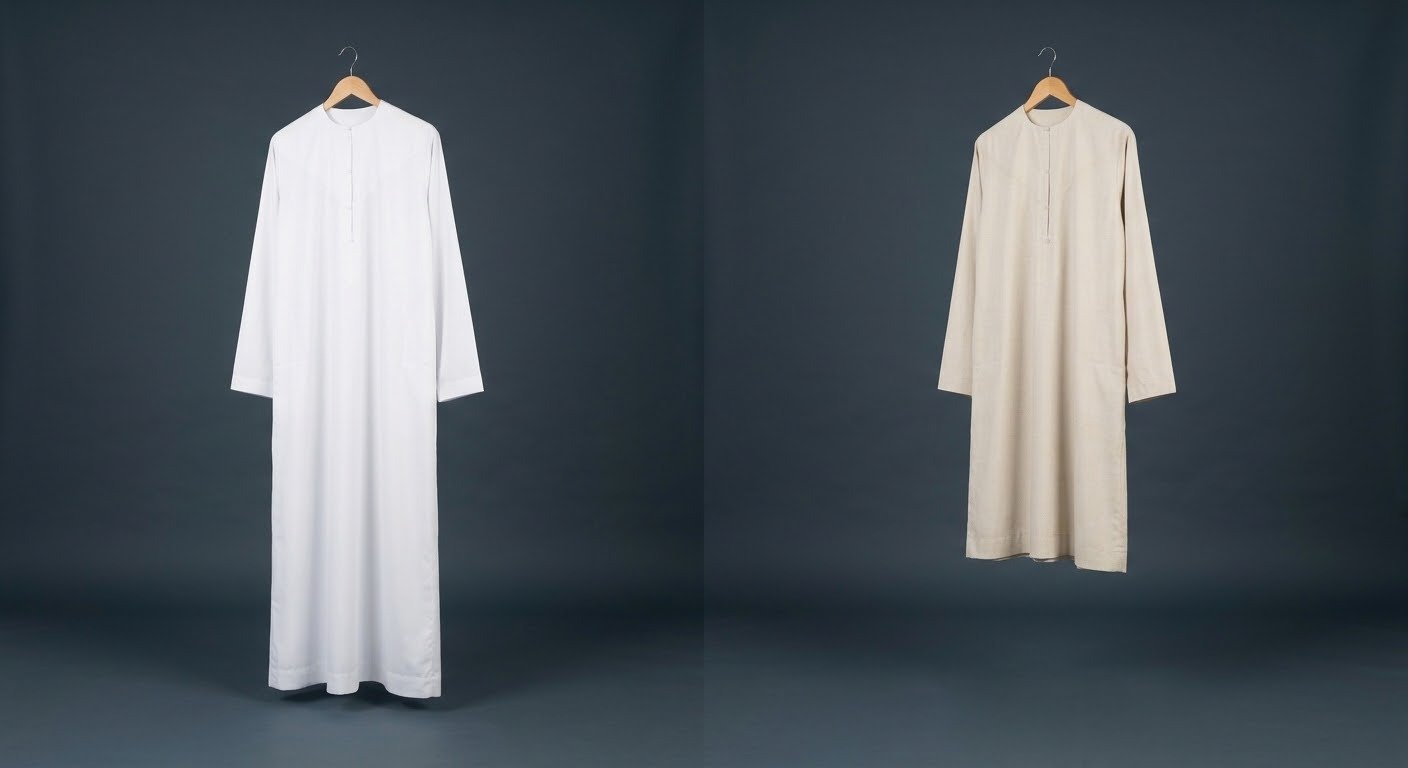
If you search one word for the ankle-length robe that covers the body and arms, use thobe. Most US stores, most search suggestions, and most English-language descriptions use it.
The word itself is plain Arabic. Thawb is the Arabic word for a dress or a garment, and English spelling varies so widely that you will see thobe, thawb, thob, and thaub used for the same item. If a listing looks unfamiliar, check the length before you buy. A genuine thobe reaches the ankle. A listing that says tunic or shirt is usually something shorter.
Beyond the spelling, the same robe carries different names by region. Once you know that, most of the confusion dissolves, because you were never comparing different garments. You were comparing labels.
What Muslim men call robes in the Arab world and the Gulf
The thobe is the everyday and formal base layer across the Arabian Peninsula. It is a long-sleeved robe, cut full and loose, usually in white or beige polyester, with wool versions for winter in the Levant. It is standard men’s formal wear in Saudi Arabia, and it is what most non-Muslims picture when they hear the phrase traditional Muslim clothing.
Regional vocabulary for that same robe shifts as you move:
| Name | Where you will hear it | Notes |
|---|---|---|
| Thobe or thawb | Saudi Arabia, Kuwait, Qatar, UAE, and US stores | The default English spelling |
| Dishdashah | Iraq, Kuwait, the Levant, Oman | Common Gulf and Levantine term |
| Kandura | UAE, and the Maghreb | Also used in Egypt and Sudan |
| Jubbah | Pakistan, India, and the wider subcontinent | The ornate South Asian version |
If you want a second layer for a wedding, a Friday prayer, or a formal visit, the word you need is bisht. A bisht is a ceremonial men’s cloak, traditionally woven from camel hair or wool, worn over the thobe at weddings, funerals, Eid, and state events. In some dialects it goes by mishlah or aba. Royalty and senior clergy get the good ones, and the fabric still advertises who wore it.
What Muslim men wear in South Asia
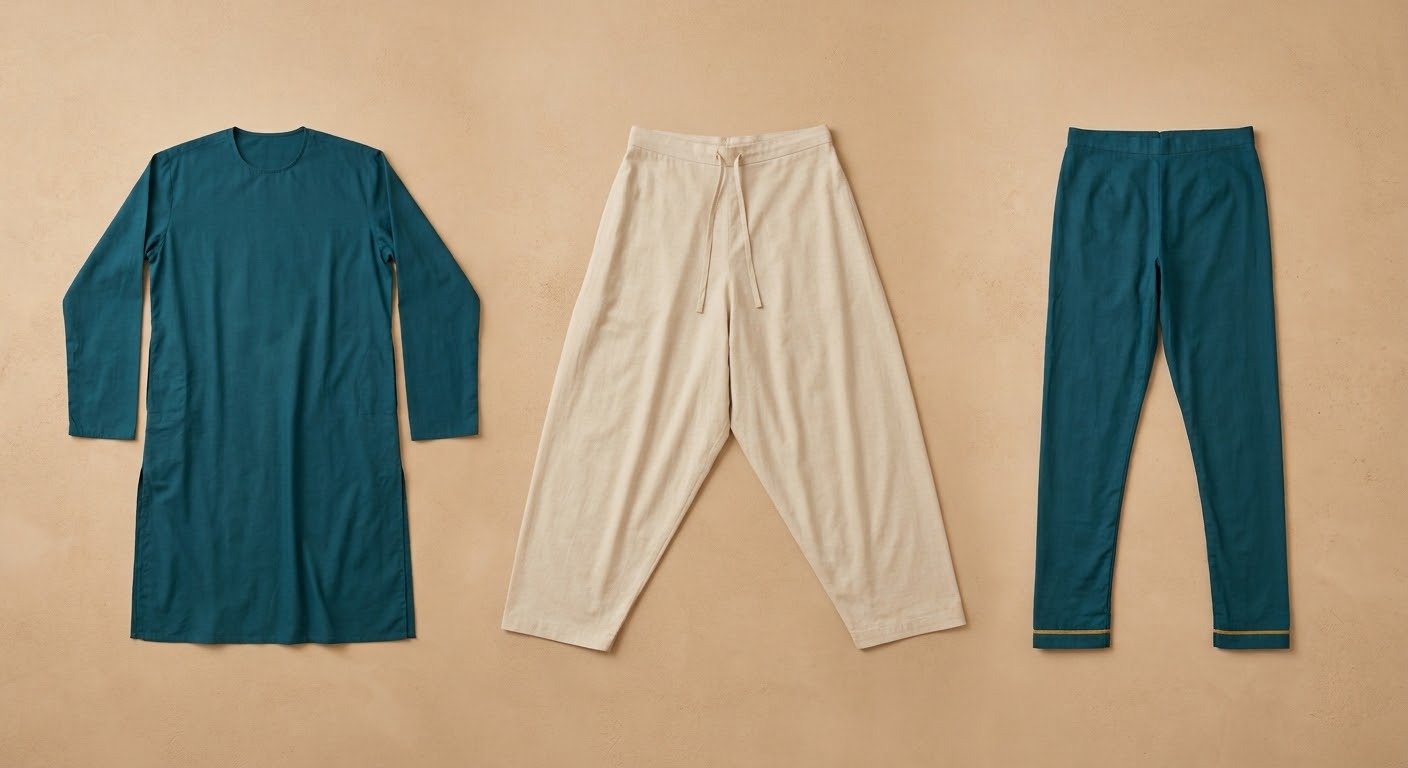
South Asia splits the outfit into separate pieces, and each piece has its own word. This is where store searches in the US get confusing fastest, because one garment here is called two things depending on who sells it.
Kurta is the base layer. It is a loose, collarless tunic that falls to around the knee, worn over loose trousers. It works for prayer, for the office on a casual day, and for Eid evening. Because it is one garment rather than a set, it is the easiest place for a beginner to start.
Shalwar kameez is the tunic plus its matching trousers. The kameez is cut straight with side seams left open below the waist, an opening called the chaak that gives the wearer room to sit and move. The shalwar is a wide trouser gathered into a drawstring or elastic waist and narrowed to a cuff at the ankle. The combination also goes by salwar suit, Punjabi suit, or Punjabi dress, which is why search results triple for every item. Cotton for daily wear, silk or brocade for weddings.
Churidar is the narrow alternative to the shalwar. A churidar is cut tight through the leg and finished with a buttoned ankle cuff, with extra length folded into stacked folds at the ankle. It is a kurta partner in South Asia and looks dressier under a long coat.
Sherwani is the wedding coat. It is a fitted, long-sleeved outer coat that falls below the knees, buttoned down the front, usually in brocade, silk, or velvet with embroidery at the collar and chest. It developed in the 19th century, when the Mughal angarkha was given a Western buttoned front.
Achkan is the simpler version of the same idea. It is a knee-length jacket, also called baghal bandi, cut straighter and worn with trousers or a churidar. When you see both words in the same search result set, the achkan is the shorter and quieter one, and the sherwani is the longer and louder one.
Khalat covers Central Asian dress. It is a loose, long-sleeved outer robe of silk or cotton, worn by both men and women in different styles.
West African and North African names
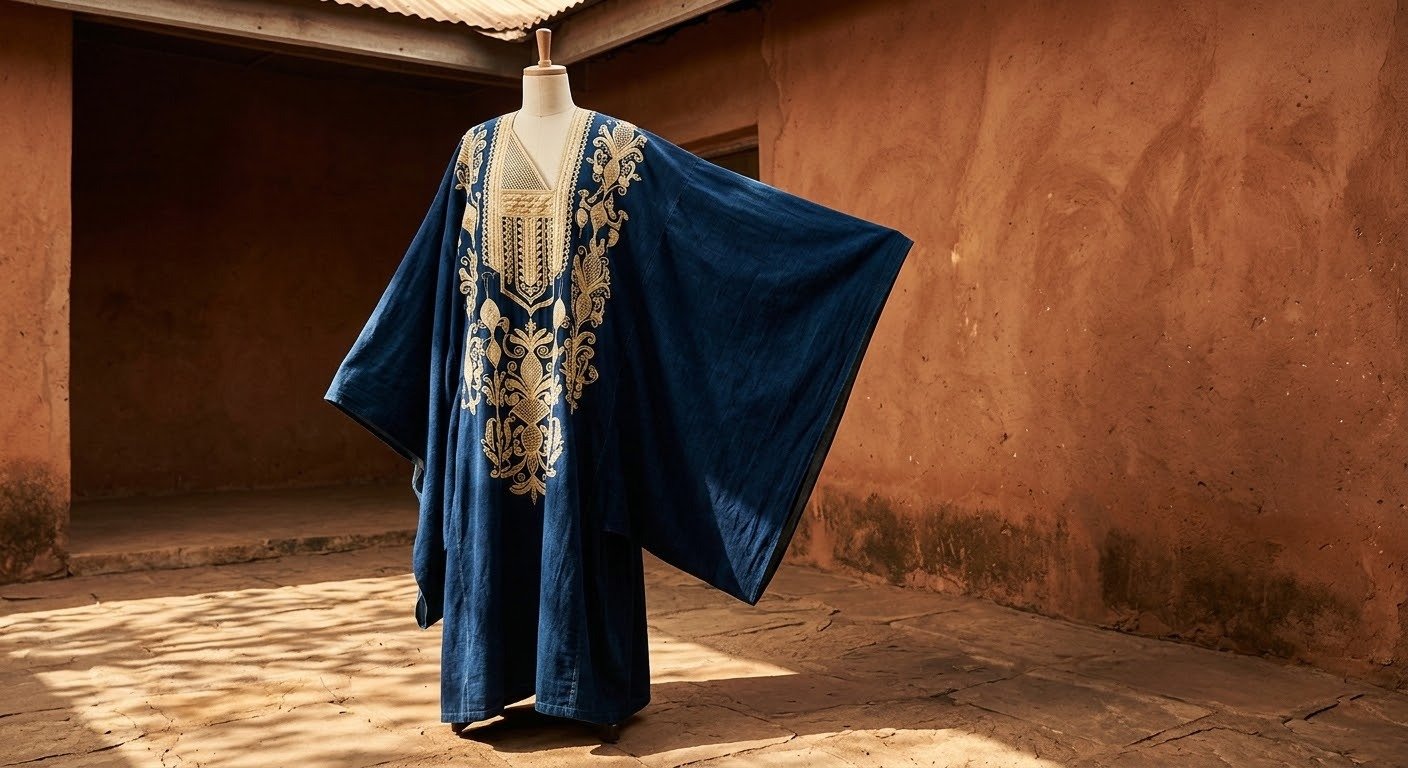
These robes are the least familiar to most US searchers, and they are also the most distinct. None of them are the thobe, even though the coverage is similar.
Agbada is the Yoruba man’s robe from southwestern Nigeria and the Republic of Benin. It is a big, loose, ankle-length garment with wide sleeves, usually embroidered front and back, and the name means voluminous attire. The full Yoruba set has four parts: the outer robe called awosoke, an undervest called awotele, long trousers called sokoto, and a hat called fila. The encyclopedia entry on the agbada notes that embroidery density depends on what the wearer can afford, which is a quick way to understand that these are status garments first and daily wear second.
Boubou is the Senegalese and Wolof relative of the agbada. Same volume, same flowing shape, different name. If someone says boubou, picture West Africa. If they say agbada, picture Nigeria.
Djellaba is the North African robe. A djellaba, also written jillaba or gallabea, is a long loose robe with long sleeves worn across North Africa, and it is often hooded. Local names exist: Algerians call it qashabiya, and Moroccan mountain dwellers call it tadjellabit.
Jellabiya is Egyptian. A jellabiya, also written jalabiya, galabeeya, or dalabiya, is a loose-fitting garment considered Egyptian national clothing, common on farmers and in everyday life. Sudanese men wear their own version, usually white and usually textured differently.
Caps, cloaks, and other named pieces
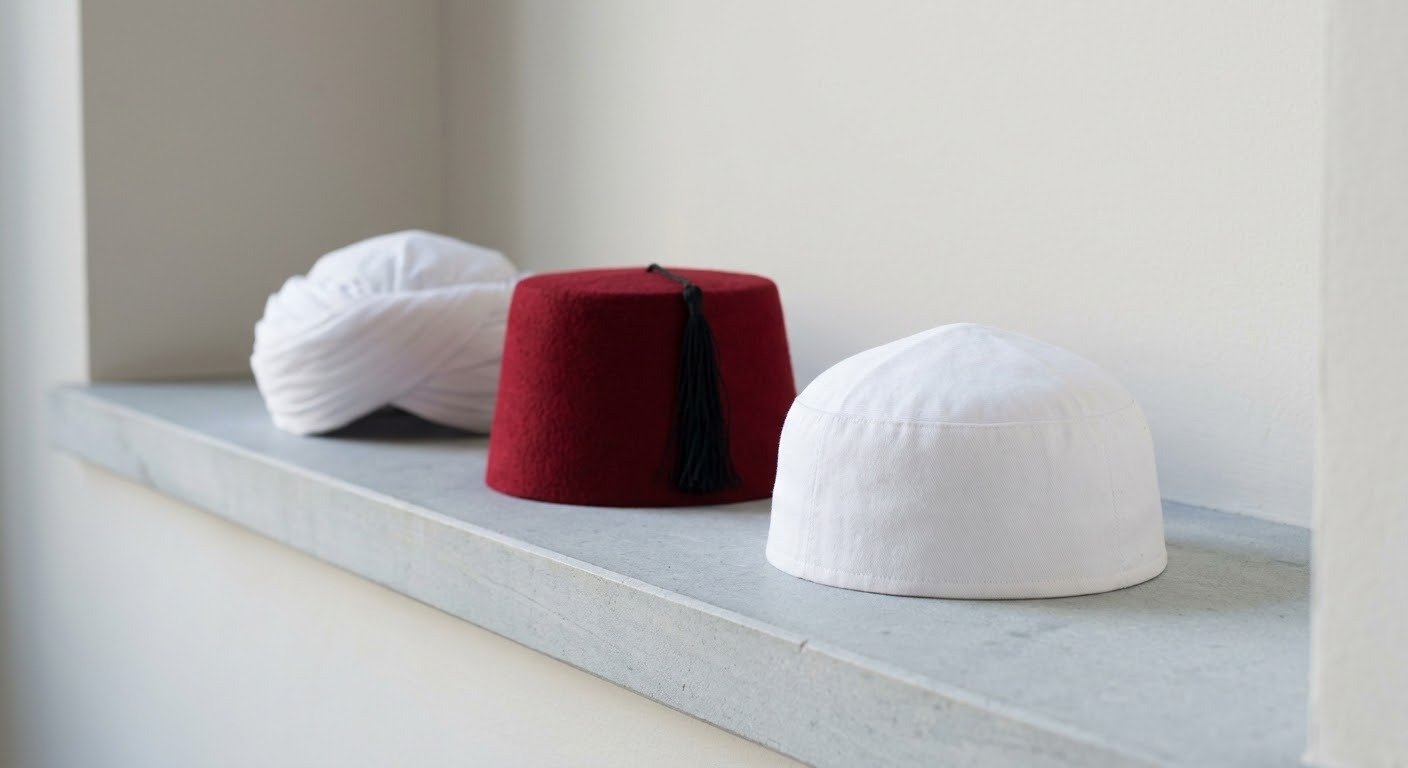
One garment, several names. The cap is the clearest example of why these searches get confusing, so here is the vocabulary side by side.
| Name | What it is | Where the name comes from |
|---|---|---|
| Taqiyah | Short rounded skullcap | Arabic term, the neutral one |
| Topi | The same skullcap | South Asia, worn with kurta and pajama |
| Kufi | The same skullcap, plus brimmed felt caps in West Africa | US and UK store name, leaning West African |
| Fez | Red cylindrical felt hat with a black tassel | Ottoman-era North Africa |
| Imama | White turban | Sudan, paired with the white jalabiyyah |
| Mishlah or aba | Ceremonial cloak worn over the thobe | Alternative dialect names for the bisht |
| Ihram | Two white cloths for Hajj and Umrah | A sacred state as much as an outfit |
If you want a prayer cap in the US, search both kufi and taqiyah, then compare. The overview of the taqiyah covers the naming history. Wearing one is a valued practice, not a requirement, and plenty of worshippers pray bareheaded.
The fez is not religious at all. It is simply the hat that goes with the robes in North Africa and West Africa. It became a symbol of the Ottoman Empire, and in 1827 it was made mandatory army headwear.
Ihram is the one entry on this list that carries religious weight rather than cultural style. A pilgrim enters it through cleansing rituals before crossing the pilgrimage boundary, so the garments matter more than the wardrobe choice.
What the names mean at weddings and at the mosque
Most US Muslims wear ordinary modest clothes to pray. A loose shirt and trousers that cover the shoulders and the knees will do. Nobody expects you to own a thobe to pray in.
If you want to dress for the mosque the way worshippers there dress, one congregation’s guidance on prayer clothing gives a clear picture of the common standard: clothing should be loose, cover the shoulders, chest and back, and cover the knees, and trouser length should not drag on the floor. Flashy neon colors and images of living beings are the two things that source flags. Different congregations differ on details, so ask if you are unsure.
That guidance lines up with how most scholars describe coverage more broadly. The common modern understanding of the awrah is that for a man it runs from the navel to the knees. Nothing in that standard requires a robe, a cap, or a specific color. The traditional garments exist because they deliver that coverage neatly and carry a region’s culture, not because they are the only compliant option.
At weddings the dress code is regional, not religious, and the names above tell you what to expect. South Asian weddings get the sherwani or an embroidered achkan. Gulf weddings get a thobe, often under a bisht. Nigerian and Senegalese weddings get the agbada or boubou with a fila or fez, and the embroidery tells you how formal the family wanted it to be. Egyptian and Sudanese weddings lean on the jellabiya.
How to shop for these clothes in the US
Start from the event, then pick the name. Walking into a store and asking for Islamic menswear gets you blank looks. Asking for a thobe, a kurta pajama set, a sherwani, or an African dishdasha gets you inventory.
A few things worth knowing before you order:
- US stores sell the Sudanese robe under several labels. African dishdasha, Sudani, and Sudanese thobe usually mean the same white robe. This naming came out of the diaspora market and has no single authority behind it.
- Measure the shoulder to hem length before ordering a thobe, and compare it against one you already own. Retail sizing is inconsistent across brands, and a thobe that is too short reads as a costume rather than a robe.
- Buy the trousers separately if you can. A kurta and a churidar fit a wider range of body types as a pair than a matching set does.
- Buy one white thobe and one festive kurta first. That covers prayer, weddings, and everyday wear without a closet full of near-identical pieces.
- Alterations are worth asking about. A tailor can fix cuffs, waist, and shoulder seams for a fraction of what a new garment costs.
Frequently asked questions
What is the name for the Muslim men’s dress?
Thobe or thawb. It is a long-sleeved, ankle-length robe worn across the Arab world, and the spelling varies because the underlying Arabic word is romanized several ways.
Is the thobe the same as a kurta?
No. A thobe is a full-length robe that stands alone. A kurta is a knee-length tunic worn over separate trousers, and it came out of South Asia rather than the Arabian Peninsula.
What do you call the loose pants?
Shalwar in South Asia, churidar when they are fitted tight to the leg. Both are worn under a kameez or kurta.
Do Muslim men have to wear a kufi?
No. Wearing a cap during prayer is a valued practice, not a requirement, and plenty of worshippers pray bareheaded. If you wear one, kufi is the US store name, taqiyah the Arabic one, and topi the South Asian one.
Is it called a dishdasha in America too?
Often, yes, especially for the Sudanese or East African white robe. In the Gulf dishdashah is the everyday word for the thobe. Same idea, different local usage.
What is a jubbah?
The South Asian name for a long ornate robe related to the thobe, common in Pakistan and India. When you see it in a US store, expect a more decorative garment than the plain Gulf thobe.
What do Muslim men wear to a wedding?
It depends on where the family is from. A sherwani in South Asia, a thobe with a bisht in the Gulf, an agbada in Nigeria, a boubou in Senegal. Ask the host or check the invitation if you want to match the dress code.
Are shorts allowed in a mosque?
Men’s mosques commonly require clothing that covers the knees. Shorts above the knee fall short of that standard. A long shirt over trousers, or a thobe, works at any mosque.
What to take away from this
There is no single Muslim dress code for men, and every name in this guide is regional rather than religious. Use them to shop, to travel, and to understand what someone means when they describe an outfit.
Pick one term per region and you can order anywhere. Thobe or dishdashah in the Gulf, thobe or jubbah in South Asia, agbada in Nigeria, jellabiya in Egypt, kurta pajama when you want one easy set.